Case Study - Gamms
Focus: Product marketing, waitlist strategy, beta launch
What Gamms Is
Gamms is a new platform designed to help users create and monetize communities, but like most new products, it faced the hardest early-stage challenge: getting people to take the first step onto something unfamiliar.
There was no existing user habit, no established trust, and no default reason for people to switch or try.
The role of product marketing and content at this stage was simple but critical:
Help users understand why the platform should exist for them — before asking them to join it.
Context
Gamms was approaching its beta launch as a completely new platform.
The objective wasn’t just collecting interest — it was moving people from curiosity to action: joining the waitlist, then showing up as active users once the beta opened.
This required more than announcements or feature highlights. It required building enough clarity and confidence for users to willingly step into something new.
The Challenge
- Getting people to commit to a brand‑new platform
- Turning waitlist signups into actual platform adoption
- Avoiding a beta launch where users signed up but didn’t meaningfully engage
The real challenge wasn’t awareness. It was trust and readiness.
Core Insight
Early users don’t join betas because of features.
They join because:
- They feel seen
- They understand the problem deeply
They want to be part of something being shaped
The waitlist needed to feel like an invitation into a journey, not a countdown to a product drop.
The Approach
Before execution, I started by creating a product marketing and content strategy document to guide all marketing implementations.
This document defined:
- The core user problem and adoption barriers
- Narrative positioning and messaging priorities
- The role of the waitlist in preparing users for the platform
- How content and email would work together to drive adoption
This ensured that every email, message, and launch touchpoint served a clear purpose.
From there, I applied a narrative-led product marketing approach, using email as the primary channel to:
- Educate before persuading
- Build trust before asking for commitment
- Position the beta as participation, not access
The work focused on sequencing and clarity, not volume.
The System
1. Narrative Framing
The product was positioned around:
- The core problem users were already experiencing
- Why existing alternatives fell short
- What Gamms was intentionally doing differently
This framing stayed consistent across all communication.
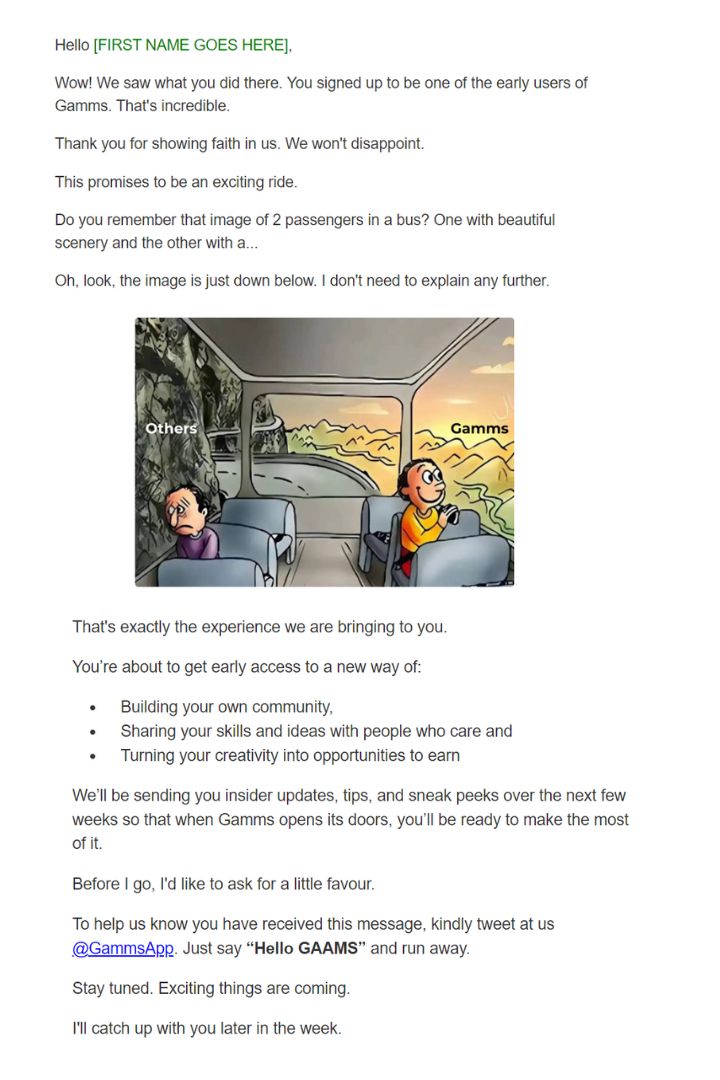
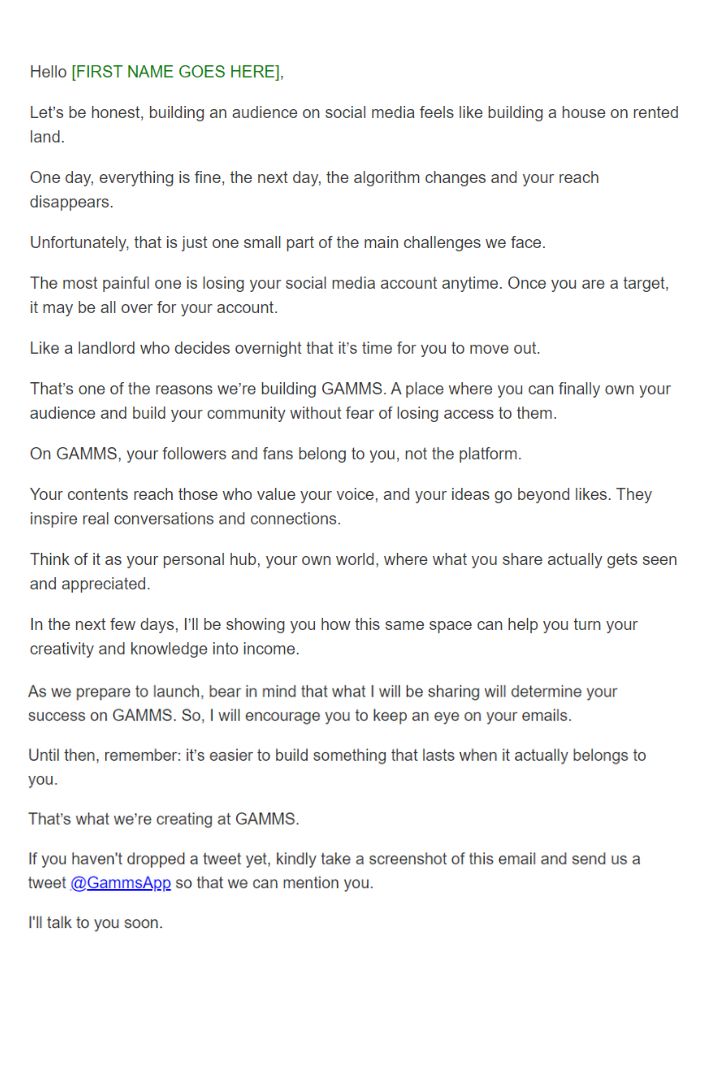
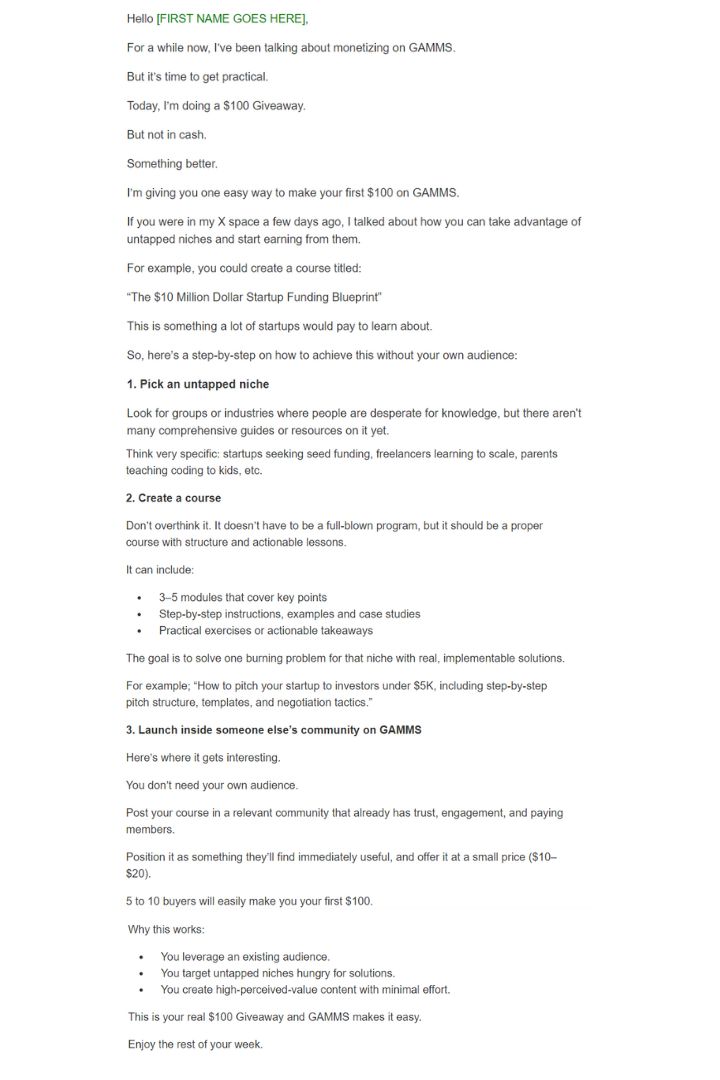
2. Waitlist Email Sequence
Instead of promotional emails, the sequence followed a progression:
- Problem clarity — naming the friction users felt
- Reframing — helping users see the problem differently
- Product intent — what Gamms was being built to solve
- Participation — why early users mattered to the product’s direction
- Beta invitation — positioned as a next step, not a pitch
Each email had a single job: move understanding forward.
3. Tone & Voice
- Conversational, not salesy
- Honest about what the product was and wasn’t yet
- Focused on trust over excitement
The goal was to reduce uncertainty, not amplify urgency.
Beta Launch Execution
The beta launch email was treated as a continuation of the narrative, not a climax.
By the time users received the beta invitation:
They already understood the product
They already trusted the intent
The call-to-action felt natural
Outcomes & Signals
The beta launch achieved strong traction for a brand‑new platform:
- 1,700+ waitlist signups in 2 months
- 500+ new active platform users shortly after beta launch
- Consistent engagement across the waitlist email sequence
- Replies indicating clarity, trust, and willingness to try something new
Crucially, users didn’t arrive confused. They arrived prepared — already understanding what Gamms was, why it existed, and what role they were playing as early users.
Supporting Artifacts
Screenshots available:
Waitlist email sequence
Beta launch email
(Shared selectively to illustrate structure, tone, and progression.)
Key Learning
When product marketing focuses on shared understanding, conversion becomes a by-product.
The role of early content isn’t to convince users to join — it’s to help them decide confidently.
This case study demonstrates how narrative sequencing and education-first messaging can support early traction without relying on hype or aggressive promotion.
Some emails I wrote:
Case Study - Gamms
Focus: Product marketing, waitlist strategy, beta launch
What Gamms Is
Gamms is a new platform designed to help users create and monetize communities, but like most new products, it faced the hardest early-stage challenge: getting people to take the first step onto something unfamiliar.
There was no existing user habit, no established trust, and no default reason for people to switch or try.
The role of product marketing and content at this stage was simple but critical:
Help users understand why the platform should exist for them — before asking them to join it.
Context
Gamms was approaching its beta launch as a completely new platform.
The objective wasn’t just collecting interest — it was moving people from curiosity to action: joining the waitlist, then showing up as active users once the beta opened.
This required more than announcements or feature highlights. It required building enough clarity and confidence for users to willingly step into something new.
The Challenge
- Getting people to commit to a brand‑new platform
- Turning waitlist signups into actual platform adoption
- Avoiding a beta launch where users signed up but didn’t meaningfully engage
The real challenge wasn’t awareness. It was trust and readiness.
Core Insight
Early users don’t join betas because of features.
They join because:
- They feel seen
- They understand the problem deeply
They want to be part of something being shaped
The waitlist needed to feel like an invitation into a journey, not a countdown to a product drop.
The Approach
Before execution, I started by creating a product marketing and content strategy document to guide all marketing implementations.
This document defined:
- The core user problem and adoption barriers
- Narrative positioning and messaging priorities
- The role of the waitlist in preparing users for the platform
- How content and email would work together to drive adoption
This ensured that every email, message, and launch touchpoint served a clear purpose.
From there, I applied a narrative-led product marketing approach, using email as the primary channel to:
- Educate before persuading
- Build trust before asking for commitment
- Position the beta as participation, not access
The work focused on sequencing and clarity, not volume.
The System
1. Narrative Framing
The product was positioned around:
- The core problem users were already experiencing
- Why existing alternatives fell short
- What Gamms was intentionally doing differently
This framing stayed consistent across all communication.
2. Waitlist Email Sequence
Instead of promotional emails, the sequence followed a progression:
- Problem clarity — naming the friction users felt
- Reframing — helping users see the problem differently
- Product intent — what Gamms was being built to solve
- Participation — why early users mattered to the product’s direction
- Beta invitation — positioned as a next step, not a pitch
Each email had a single job: move understanding forward.
3. Tone & Voice
- Conversational, not salesy
- Honest about what the product was and wasn’t yet
- Focused on trust over excitement
The goal was to reduce uncertainty, not amplify urgency.
Beta Launch Execution
The beta launch email was treated as a continuation of the narrative, not a climax.
By the time users received the beta invitation:
They already understood the product
They already trusted the intent
The call-to-action felt natural
Outcomes & Signals
The beta launch achieved strong traction for a brand‑new platform:
- 1,700+ waitlist signups in 2 months
- 500+ new active platform users shortly after beta launch
- Consistent engagement across the waitlist email sequence
- Replies indicating clarity, trust, and willingness to try something new
Crucially, users didn’t arrive confused. They arrived prepared — already understanding what Gamms was, why it existed, and what role they were playing as early users.
Supporting Artifacts
Screenshots available:
Waitlist email sequence
Beta launch email
(Shared selectively to illustrate structure, tone, and progression.)
Key Learning
When product marketing focuses on shared understanding, conversion becomes a by-product.
The role of early content isn’t to convince users to join — it’s to help them decide confidently.
This case study demonstrates how narrative sequencing and education-first messaging can support early traction without relying on hype or aggressive promotion.
Some emails I wrote: